Finding community, connection and a career path at Durham College

Jazmyn Romano’s time as a student at Durham College (DC) was meaningful both personally and professionally.

A two-time DC graduate who grew up in Bowmanville, she completed the Paralegal program in 2024 and Law Clerk – Advanced in 2025.

Now she’s found her way back to DC as a new member of the Durham College Alumni Association (DCAA) Board of Directors.

“I thought that once I graduated, my time at DC was done,” she said. “But it’s great to be able to get involved as an alumnus. I had a great experience here, and it’s nice to have the opportunity to give back to a campus that gave so much to me.”

The education she received at DC started her down the path towards a career in law, and her schooling has continued remotely as she works towards an international law degree at the University of London.

“I have an interest in justice because it’s an area where you have the ability to help people and make actionable change,” said Romano.

She’s already been able to make use of some of the lessons she learned in her DC programs. During her studies, she launched her own successful company – Romano Remote Virtual Assistant Services – providing business process outsourcing for a number of clients. Its success has kept her busy since she crossed the stage at Convocation.

“The bulk of my clients are realtors, and I studied real estate law in the Law Clerk program,” she explained. “That was a good foundation in figuring out the real estate market, how to work with realtors, and especially drafting the various forms that are needed.”

But her most valuable time at DC may have been the hours she spent at the First Peoples Indigenous Centre (FPIC), in the company of Dr. Kayla Murphy, Director, Indigenous Initiatives.

“My family is Métis. My grandma was adopted, so there’s a little bit of an intergenerational disconnect there. Going into college, I had a hard time with my own identity,” said Romano. “With my upbringing and that disconnect in mind, and because I look European, my connection to my Indigenous identity has sometimes felt complicated. My lived experiences are different from those of many other Indigenous people, and I acknowledge that. In turn, sometimes it’s a little difficult to connect with other people in the Indigenous community.”

Through discussions with Dr. Murphy, and simply spending time in the friendly confines of FPIC, she developed a new understanding of her Indigenous background.

“She taught me a lot. Through talking with Kayla and learning from her, it definitely helped me feel like I belong.”

She’ll continue to embrace her Indigeneity by attending events like DC’s Orange Shirt Day Mini Powwow on Wednesday, September 30, where the campus community will gather in recognition of the day as well as the National Day for Truth and Reconciliation. And in her role with the DCAA, she will stay connected to her post-secondary home and serve as a voice for her fellow alumni.

“I’m excited to see where it goes, and how I can help.”

Indigenous artist shares meaningful art with Durham College

Artistic expression has always been a passion for Emma Whiteye, and her creativity is leaving a mark outside of the classroom.

The Fine Arts – Advanced student and proud member of Walpole Island First Nation arrived at Durham College (DC) last fall. Having worked in a variety of artistic disciplines since childhood, she has spent her first year in the program honing and developing her already impressive skills.

“I like all the arts,” she said. “It’s fun to try something new for each little thing.”

When an assignment tasked her with producing a scroll-style painting, she decided to create a painted representation of the 13 Moons, a teaching from Anishinaabe tradition. Each of the moons represents a new teaching, a change in nature and a cultural tradition.

After working hard for two weeks, she completed a beautiful piece that caught the eye of Dr. Kayla Murphy, Director of Indigenous Initiatives at DC.

It impressed DC leadership as well and now reproductions of the artwork are displayed at both the Oshawa and Whitby campuses.

“I was shocked. I couldn’t believe it,” she said of learning her piece would be hung on the walls for all to see. “I’m really excited that it’s there.”

With the art now unveiled, Dr. Murphy, also a member of Walpole Island First Nation, is pleased to see a profound interpretation of Indigenous teachings featured so prominently on campus.

“It’s important to see that reflection of self and voice, and to have that representation within the institutions where students can see themselves within academia,” said Dr. Murphy.

While everyone at DC can appreciate the art for its colour and craft, Whiteye is confident that her fellow Indigenous students will find particular meaning in it.

“Even if they know nothing about the 13 Moons, they’ll see it and be like, ‘that’s part of my culture,’” said Whiteye. “It’s just something new that they can learn.”

The artwork is on display in Oshawa’s Gordon Willey Building, South Wing across from the Learning Commons, and in the main entrance of Whitby’s Don Lovisa Building. You can learn more about the 13 Moons online.


Indigenous student embraces and shares his culture at Durham College

To reach Durham College (DC), Jakob Henry Olive travels 10 hours south from his home in Michipicoten First Nation near Wawa, Ontario. While Oshawa may be far away, the Anishinabek/Ojibwe student has made DC his destination twice now, graduating from the Electrical Techniques program before entering his current Computer Programming program that he is set to graduate from in 2025.

Olive said he originally decided to come to DC because Oshawa seemed like the right-sized city for someone who had previously lived in a town of 3,000.

“Growing up, I was always up north, so I came to the conclusion that I needed to venture out and expand my mindset, and I knew I didn’t have it in me to live in downtown Toronto. I felt Durham and Oshawa was the perfect middle ground,” he said. While he plans to stay down south for a while, eventually Olive plans to return up north and work in IT.

At DC, Olive is a regular at the First People’s Indigenous Centre (FPIC), meeting with other members of the Indigenous community and occasionally attending events such as the National Day for Truth and Reconciliation and the Fall Feast. He says it’s a great quiet place on campus to do homework as well. He also recently connected with the DC Indigenous Education Circle and the Indigenization Council as a student member to share his experiences.

“I look at almost everything daily through an Indigenous perspective. Quite often it’s in conversation with other people, sharing stories, sharing experiences, and communicating almost nonverbally and verbally at the same time. Indigenous people have such a connection that it’s difficult to explain,” he said. “It’s a very close-knit group of people, almost like a family, a miniature Indigenous community within Durham College.”

Asked how he brings his Indigenous self to campus personally, Olive muses that he tries to do so daily. “Being raised up north and in a community, I bring my identity into everything, even into my computer programming. I feel like there’s lots of opportunity for me to bring up the inequalities that northerners have compared to people who live in the GTA, and the technological divide that’s evident, even more so since the pandemic,” he said, noting that his community only got high-speed internet about three years ago. 

Olive said he is eager to help others at DC learn more about the north and help build stronger relationships with nearby nations. “I’m hoping I can come forward with good recommendations for the Indigenization Council.”

Besides his studies, Olive is also an avid bead worker, a passion that started during the pandemic and now brings joy to his life. His first project was a simple pair of earrings with sky blue and fire colours along the sides.

Three years later, Olive still beads every day, in the morning as he drinks his coffee and, in the evening, after he finishes his studies. Creating new work regularly from earrings to dreamcatchers to wristlets, he sells his work through his brand Niished Out Beadwork at pow-wows, conferences, and cultural events.

Olive is planning to explore the offerings through FastStartDC, an extracurricular program that helps DC students develop and launch their businesses.

He’ll also continue to find community at FPIC, which he describes as a good place to facilitate conversations, (sometimes hard conversations) about the reality of First Nations life. “The conversations that arise from the events are what I enjoy most. To my knowledge, there is no other place in North Oshawa to have these conversations in safe, ‘community-based’ surroundings, which First Nations students would be familiar with.”


Explore Indigenous spaces on the Durham College campus

Durham College (DC) is committed to providing a warm and welcoming environment for Indigenous students and employees and providing space for meaningful conversations and reflection to take meaningful steps towards reconciliation.

Providing these spaces for Indigenous students – and making them visible for all to see – is paramount, according to Sherry Miller, Indigenous Student Success Coordinator.

“Growing up in Toronto, there was no representation or signs of Indigenous life anywhere,” she said. With landmarks like the Medicine Wheel and the Weeping Willow tree, as well as the beautiful Indigenous art displayed throughout the First Peoples Indigenous Centre (FPIC), she’s proud that’s not the case at DC.

“For Native people, being in a space and seeing those symbols is huge. It’s proof that you belong here, that you live here.”

Here are three places at our Oshawa campus where you can pause for reflection and learning.

  • Suswaaning Endaajig – First Peoples Indigenous Centre

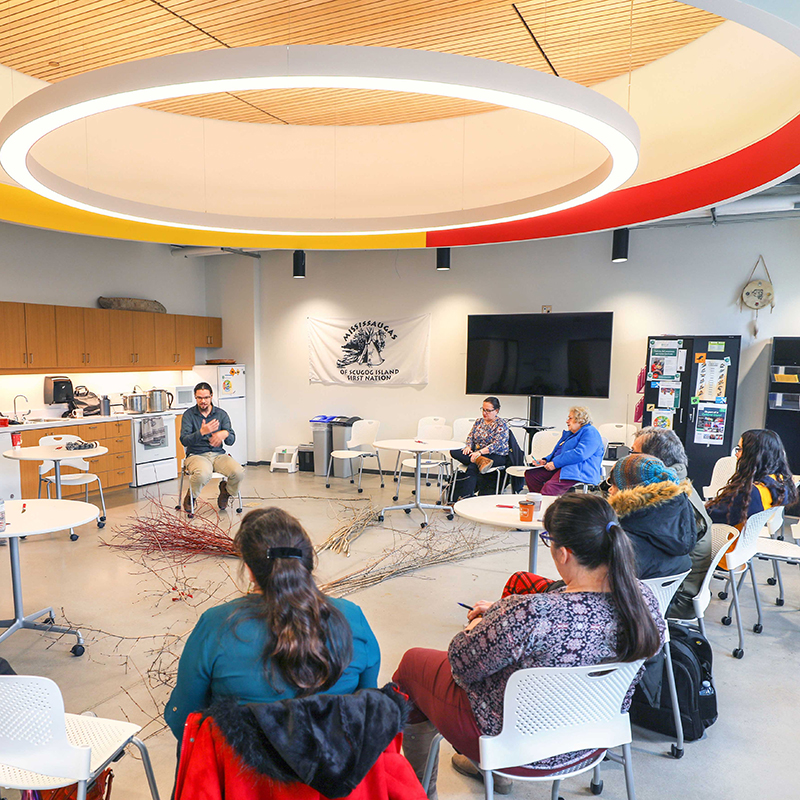
    The doors of the First Peoples Indigenous Centre (FPIC) are open to all at DC, and the space can accommodate a number of uses. It’s located in the Centre for Collaborative Education (CFCE), Room 141, and students are free to stop in for a respite from campus life, grab some coffee or a snack, and enjoy a quiet spot to study. They can also utilize the Elder’s Room to reflect or perform a smudging, a sacred ceremony in which traditional medicines like sage, cedar and sweetgrass are burned to purify body, mind, heart and Spirit.

    A number of resources are available to help Indigenous students learn more about their culture and communities. The FPIC team - Dr. Kayla Murphy, Director of Indigenous Initiatives; Kiana Cress, Indigenous Communities Outreach Coordinator; and Sherry Miller, Indigenous Student Success Coordinator – is always happy to connect with students, share their wisdom and provide guidance, or just have a friendly chat.

  • Naanaagide’endamowin Courtyard

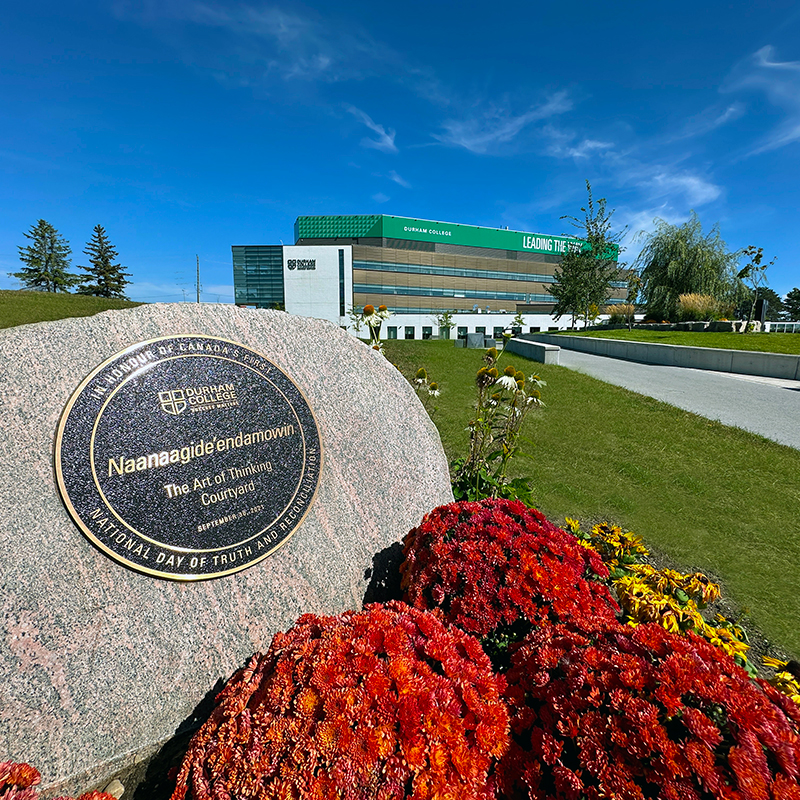
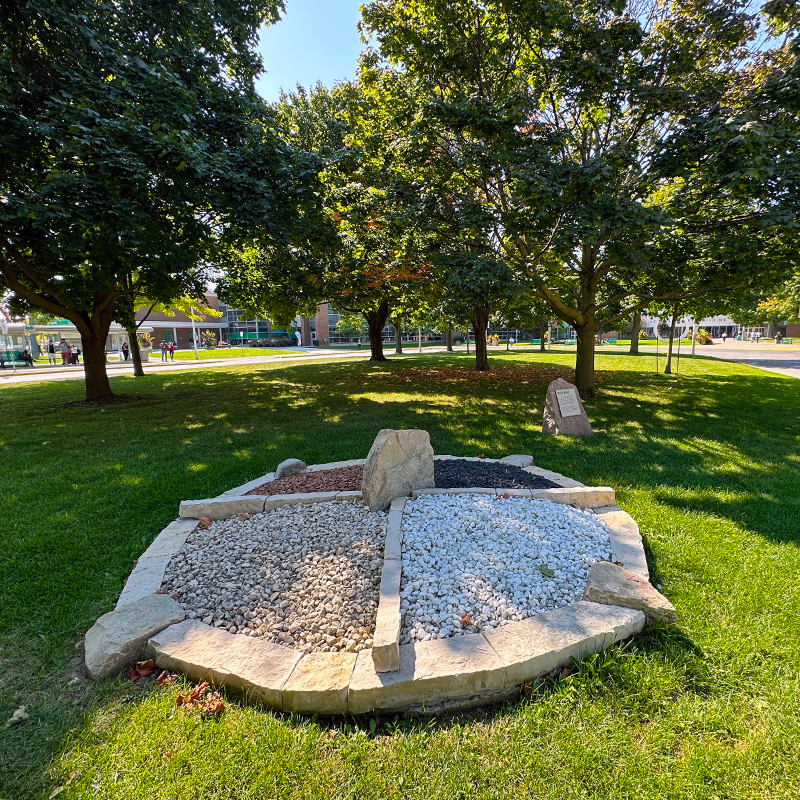
    The courtyard next to the CFCE is a great place to enjoy fresh air and sunshine, but it’s also an Indigenous learning space gifted an Anishinaabemowin name, Naanaagide’endamowin (The Art of Thinking), by Elder, Dr. Shirley Williams. Observant visitors will find six QR codes to scan, which will take them directly to information about Land Acknowledgements, the Indigenous Histories Modules, 13 Moons, Sacred Medicines, upcoming events, and the Weeping Willow at the centre of the courtyard.

    The tree was planted in 2021 in memory of the Indigenous children who did not make it home from residential schools. A willow was chosen for its ability to bend without breaking, a trait also found in the resilient Indigenous communities of Canada.

  • Medicine Wheel

    The Oshawa bus loop is home to a Medicine Wheel rock garden. Installed in 2014, it is fittingly located on the bus loop island, where it can serve as a spot for quiet reflection in the middle of our bustling campus.

    Used as a teaching and learning tool in Indigenous cultures, the Medicine Wheel represents the interconnectedness that exists in ourselves and the world around us. The wheel’s four quadrants - spiritual, physical, mental and emotional – promote balance in one’s life and living in harmony with all creation.

Durham College is dedicated to advancing truth and reconciliation by weaving Indigenous knowledge and perspectives into the fabric of our campus. Explore this content collection to learn about the resources, supports and opportunities that are available on campus.


Prioritizing Indigenization inside and outside the classroom

For Durham College’s (DC) Faculty of Media, Art & Design (MAD), actively embedding Indigenous perspectives and knowledge directly into program curriculum is critical to fostering a learning environment that honours and reflects the voices of Indigenous communities.

“Our goal is to provide students with opportunities to engage with Indigenous perspectives in a meaningful way,” says Barry Waite, Executive Dean, Faculty of MAD, DC. “Whether through podcasting, international collaborations, or coursework, we want to ensure students gain a deep understanding of Indigenous viewpoints and experiences, and how to share these stories responsibly.”

One way is through Enactus DC, where students recently produced a podcast series, Founder’s Drive, aimed at highlighting the stories of young Indigenous entrepreneurs. This project, celebrated at the Enactus Canada Regional Exposition, not only amplifies Indigenous voices but also inspires students by showcasing the potential of social entrepreneurship in Indigenous communities.

Navraj Sandhar, a recent graduate from DC’s Journalism and Creative Writing program, was the project lead for season two of Founder’s Drive, and said it was an eye-opening journey in many ways. “The Indigenous focus of this season intrigued me from the very beginning. I had the privilege of learning directly from community leaders during our trips to Akwesasne territory and the Native Canadian Centre of Toronto,” he said. “Each conversation taught me more about Indigenous ways of thinking and learning, like how entrepreneurship can be used as a tool for preserving traditions, supporting the community, and creating something that lasts for future generations.”

Looking forward to its next Faculty Lead Classroom Abroad (FLCA) trip this fall, Waite reflected on DC’s FLCA trip to Guatemala last October, where students worked alongside Mayan youth to create and share stories about Indigenous rights in Canada and Guatemala. “The trip not only broadened students’ worldviews but also allowed them to witness firsthand the importance of storytelling in Indigenous cultures,” he adds.

Additionally, first-year students in DC’s Broadcasting – Radio and Contemporary Media program take the course Indigenous Perspectives in Contemporary Media, which addresses the Truth and Reconciliation Commission Calls to Action, particularly around the role of media. This is further complemented by the Journalism – Mass Media program, where students explore impactful storytelling with Indigenous communities through elective courses.

“Indigenous content isn’t just an addition to our programs,” Waite says. “It’s an essential part of preparing students to be culturally aware and socially responsible communicators.  It also reflects our commitment to meeting Recommendation 86 from the Truth and Reconciliation Commission that calls on media schools to provide robust education about the experience of Indigenous peoples in Canada.”

These initiatives within DC’s Faculty of MAD contribute to the college’s broader mission to equip students with the tools to engage with reconciliation efforts meaningfully, and as storytellers, ensuring that Indigenous voices are not only heard but also respected and amplified.


Durham College is dedicated to advancing truth and reconciliation by weaving Indigenous knowledge and perspectives into the fabric of our campus. Explore this content collection to learn about the resources, supports and opportunities that are available on campus.

Photo Credit: Founders Drive


Discover the Indigenous Learning Modules at Durham College

Durham College (DC) is committed to the ongoing process of reconciliation and building respectful, reciprocal relationships that contribute to better educational outcomes for all students and a stronger community.

A critical part of that work is through education and creating an inclusive and diverse learning environment that enhances understanding and appreciation of Indigenous histories, cultures, and contributions.

To support our communities’ continued learning, DC offers a free, online, seven-module training course – Indigenous Histories and Reconciliation. These modules, created to support DC’s Indigenization Statement, aim to give an accurate history of Canada’s dealings with Indigenous communities, redefine Canadian identity through truth and reconciliation, and enhance personal and professional development. By building a network of faculty, staff, and students committed to lifelong learning about Indigenous issues, DC is creating a culture of respect, understanding, and equality.

True to Indigenous ways of learning and knowing, the course invites participants to discover their own ways of learning. Its seven modules – Love, Respect, Honesty, Humility, Bravery, Truth and Wisdom – can be taken in any order and provide a framework for post-secondary institutions to adapt to fulfill commitments outlined in the Truth and Reconciliation Commission (TRC) Calls to Action.

Topics include:

  • Treaties and Dynamics Between Settlers and Indigenous Peoples: Reflecting on the historical agreements and relationships between Indigenous communities and settlers and the complexities and misinterpretations that have influenced these interactions.
  • Residential Schools: Examining the impact of residential schools on Indigenous children, families, and communities.
  • Missing and Murdered Indigenous Women and Girls: Tackling the urgent issue of violence against Indigenous women and girls, shedding light on the systemic factors contributing to this crisis and the ongoing efforts for justice and healing.
  • Decolonization: Promoting the value of Indigenous knowledge and approaches, fostering a more equitable society.
  • Intergenerational Trauma: Exploring how historical trauma affects Indigenous communities today and paths to healing.
  • Resiliency of Indigenous Communities: Celebrating the strength and resilience of Indigenous peoples, this module highlights stories of survival, resistance, and cultural revitalization.

These modules are available online for everyone. Participants will receive a digital recognition of completion after each module.


Durham College is dedicated to advancing truth and reconciliation by weaving Indigenous knowledge and perspectives into the fabric of our campus. Explore this content collection to learn about the resources, supports and opportunities that are available on campus.