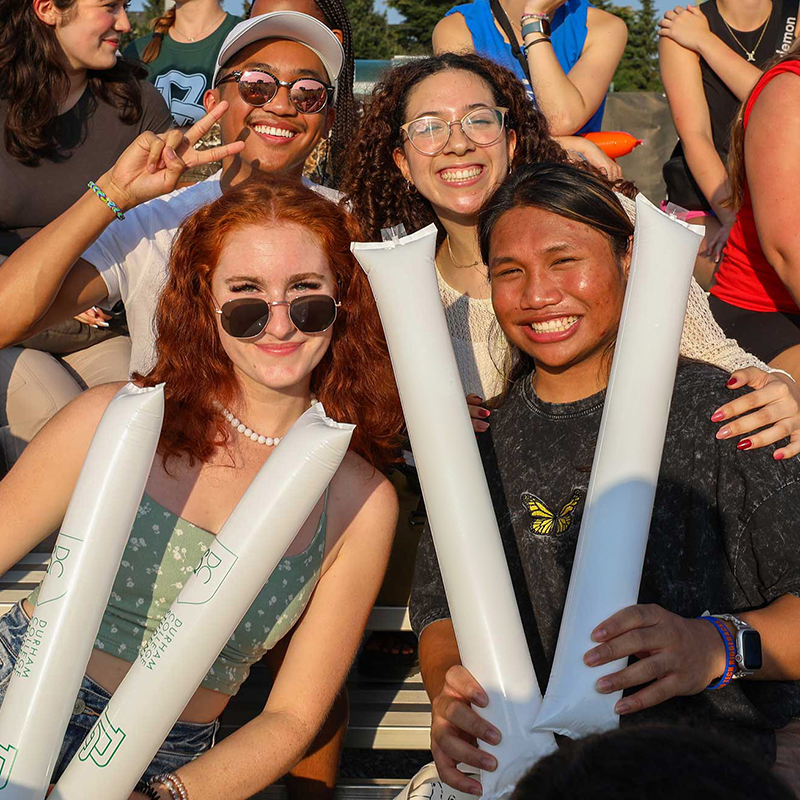
A mix of student and alumni success stories and helpful tips that will help you on your college journey, our 2024 blogs painted a picture of campus life, student supports and the limitless potential that comes with pursuing a Durham College (DC) education.
Browse our top blogs for 2024 and share your story with us for a chance to be featured in the new year!
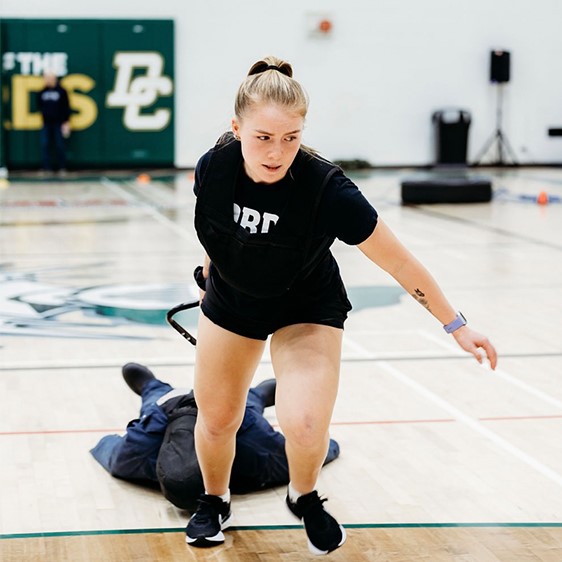
Award-winning Police Foundations grad extending her stay at DC
Meet Maya, an award-winning Durham College Police Foundations graduate who is continuing her journey at DC to further her academic and professional goals by pursuing an Advanced Law Enforcement and Investigations graduate certificate.
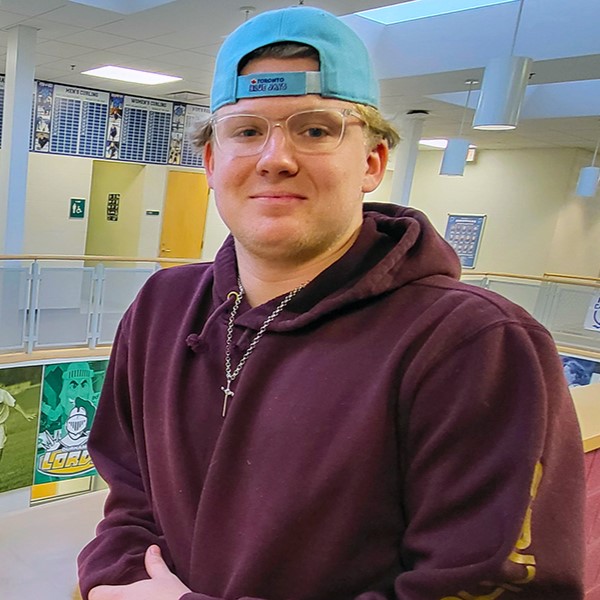
Sport Management student following in his uncle’s DC footsteps
For Coulter, studying Sport Management is something of a family tradition as he pursues his passion at DC, just like his uncle did almost two decades ago. Read about how DC is helping him carve out his own path in the sports industry.
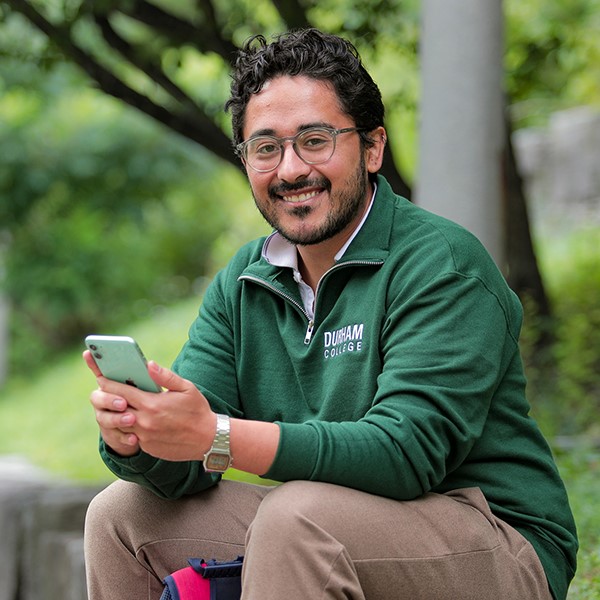
Launch your education with a fundamentals program at DC
Our fundamentals programs are designed to help students kickstart their academic journey and prepare for future success. Learn why these programs are a perfect first step for anyone considering college.
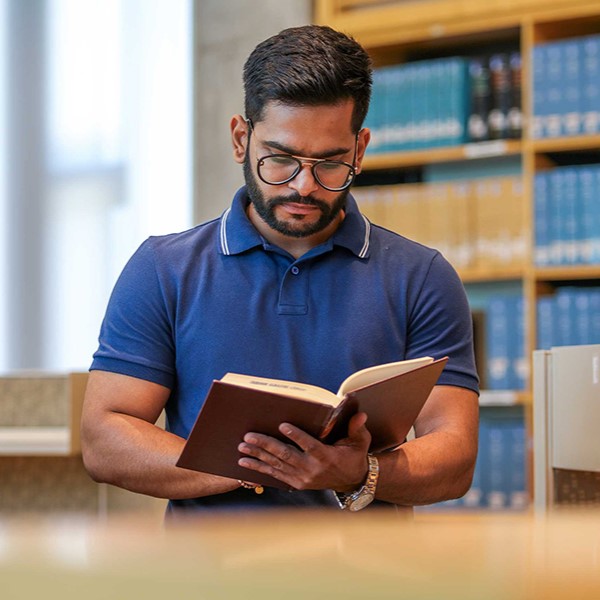
With a natural charisma and a passion for sports, Haspreet dove into extracurriculars at DC and became the voice of the Durham Lords sparking a new career path in broadcasting.
Recently featured in Forbes, Britney is a DC alumna making waves in the marketing world with her creative vision and professional drive. Find out how a DC education serves as a foundation for her success.
Thinking about earning a degree? Explore DC programs that integrate theory with intensive applied learning, setting you up for success after you graduate.
DC alumna plays a key role for storied NHL franchise
With experience working for the Nashville Predators, Edmonton Oilers and now the Boston Bruins, Laurenne says her time at DC served as an important stepping stone for her career.
With these five tips, you’ll be ready to make a lasting impression at the 2025 Job Fair. Follow @GetHiredDC on Instagram to learn more about the Oshawa campus job fair on February 6 and our Whitby campus fair on February 13.
Thinking about returning to school? Here’s how Durham College empowers mature learners
Did you know more than 60 per cent of DC students build work and life experience before enrolling in their program? Returning to school as a mature learner is a big decision, and Durham College is here to support you every step of the way.
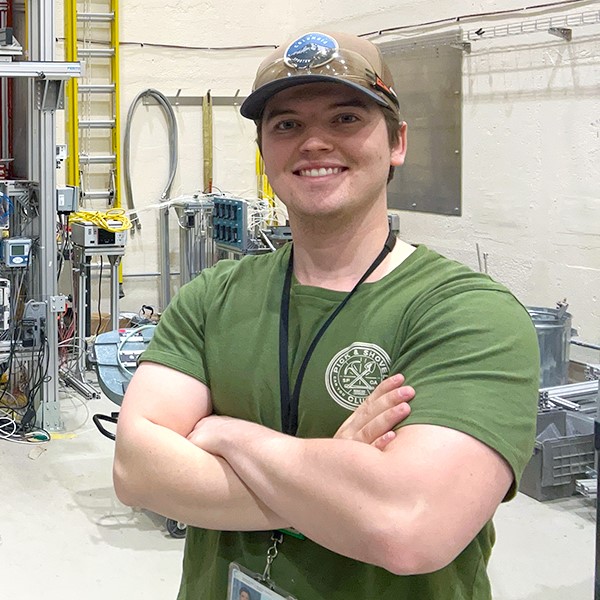
Leading the way in engineering: How Grant Forgie set himself up for success with a DC education
With a passion for STEM, Grant leveraged his advanced diploma in Electromechanical Engineering Technology into a role as a Research and Development Technologist at Canadian Nuclear Laboratories where he works with a team of Ph.D. researchers and technologists specializing in the field of advanced reactor safety experiments and analysis.
When planning your academic future, you need all of the right info to make it count. At Durham College (DC), our student recruitment team is ready to help you explore every option.
You may meet one of our recruiters at an event like Open House, out in the community at the Oshawa Centre or they may come to you for a presentation at your school. Wherever you encounter them, they’re here to give you the inside scoop on DC from our two modern and inviting campuses to our 145+ market-driven programs and beyond.
“We are the people who know a little bit about everything,” said Rachel Beerman, Student Recruitment Marketing Specialist.
Whether you’re still considering your future goals and career path, or need to ensure you meet the admission requirements for your program of choice, our recruiters will guide you every step of the way until you’re ready to submit your application and begin your DC journey.
There’s no shortage of reasons why prospective students should consider a future at DC, according to Maico Padillo, Student Recruitment Officer.
“We’re a mid-sized college; we’re not too small and not too big. We’re the perfect size for a student that’s looking for a community,” he said.
He also highlights the wealth of hands-on learning opportunities that will allow students to put their studies to the test, from field placements to co-op roles and work-integrated learning projects.
“A ton of our programs give you real-world experience before you graduate, giving you an advantage when you hit the job market. We bridge the gap between theory and practice.”
There are also a number of unique opportunities provided by DC’s close relationship with Ontario Tech University. Many programs are designed to provide a direct pathway from college to university. Even students who don’t transfer will benefit from the many resources provided at shared facilities like the Campus Library and Campus Recreation and Wellness Centre.
Although recruiters encounter thousands of prospective students each year, they’re always happy to see familiar faces turn up on campus.
“It’s a really rewarding experience when you’ve been working with somebody for a period of time, and they choose a program and they get in, and they’re really excited about it,” said Beerman.
Padillo is also passionate about helping people find their place at DC.
“When students approach me on campus and say, ‘I finally made it’, it makes me so happy,” he said. “Getting to see those students really brings it all together.”
Connect with our student recruiters today and learn more about DC. You can schedule a virtual one-on-one appointment with a student recruitment officer, book a campus tour or join us at Open House on Saturday, November 9.
Durham College (DC) is committed to providing a warm and welcoming environment for Indigenous students and employees and providing space for meaningful conversations and reflection to take meaningful steps towards reconciliation.
Providing these spaces for Indigenous students – and making them visible for all to see – is paramount, according to Sherry Miller, Indigenous Student Success Coordinator.
“Growing up in Toronto, there was no representation or signs of Indigenous life anywhere,” she said. With landmarks like the Medicine Wheel and the Weeping Willow tree, as well as the beautiful Indigenous art displayed throughout the First Peoples Indigenous Centre (FPIC), she’s proud that’s not the case at DC.
“For Native people, being in a space and seeing those symbols is huge. It’s proof that you belong here, that you live here.”
Here are three places at our Oshawa campus where you can pause for reflection and learning.
Suswaaning Endaajig – First Peoples Indigenous Centre
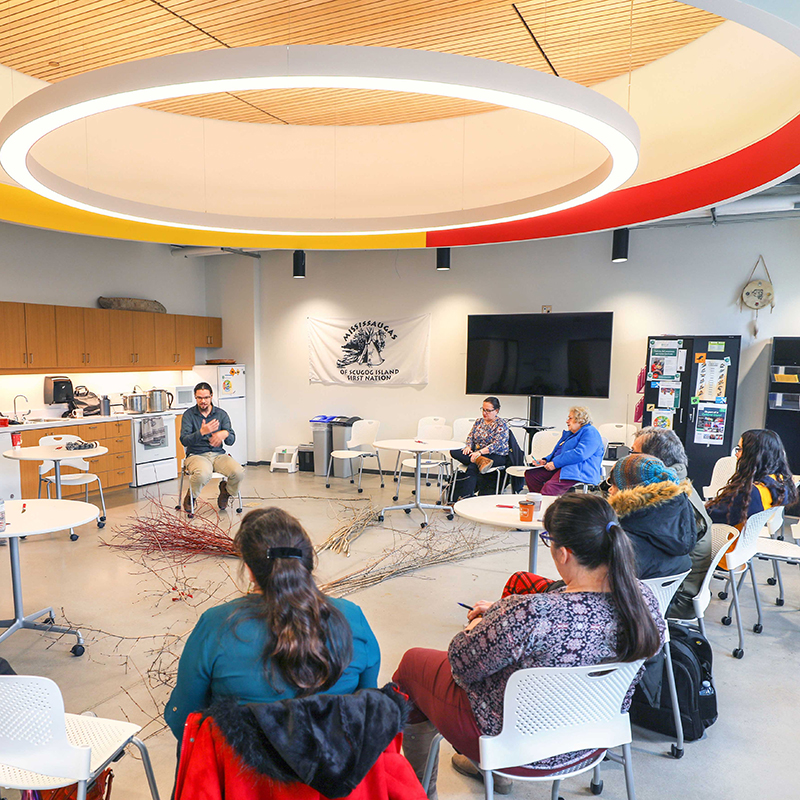
The doors of the First Peoples Indigenous Centre (FPIC) are open to all at DC, and the space can accommodate a number of uses. It’s located in the Centre for Collaborative Education (CFCE), Room 141, and students are free to stop in for a respite from campus life, grab some coffee or a snack, and enjoy a quiet spot to study. They can also utilize the Elder’s Room to reflect or perform a smudging, a sacred ceremony in which traditional medicines like sage, cedar and sweetgrass are burned to purify body, mind, heart and Spirit.
A number of resources are available to help Indigenous students learn more about their culture and communities. The FPIC team - Dr. Kayla Murphy, Director of Indigenous Initiatives; Kiana Cress, Indigenous Communities Outreach Coordinator; and Sherry Miller, Indigenous Student Success Coordinator – is always happy to connect with students, share their wisdom and provide guidance, or just have a friendly chat.
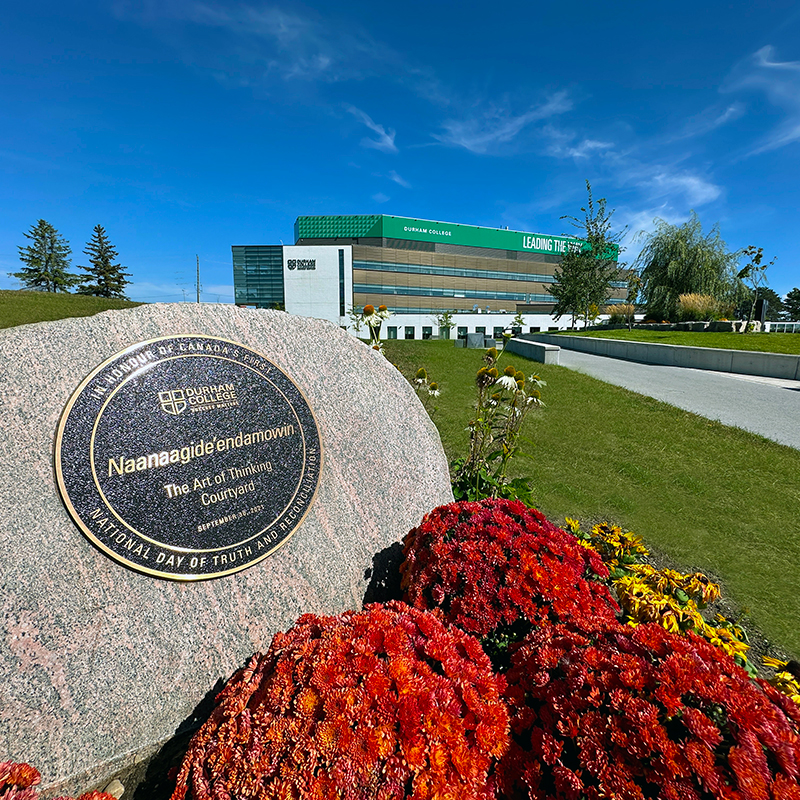
Naanaagide’endamowin Courtyard
The courtyard next to the CFCE is a great place to enjoy fresh air and sunshine, but it’s also an Indigenous learning space gifted an Anishinaabemowin name, Naanaagide’endamowin (The Art of Thinking), by Elder, Dr. Shirley Williams. Observant visitors will find six QR codes to scan, which will take them directly to information about Land Acknowledgements, the Indigenous Histories Modules, 13 Moons, Sacred Medicines, upcoming events, and the Weeping Willow at the centre of the courtyard.
The tree was planted in 2021 in memory of the Indigenous children who did not make it home from residential schools. A willow was chosen for its ability to bend without breaking, a trait also found in the resilient Indigenous communities of Canada.
Medicine Wheel
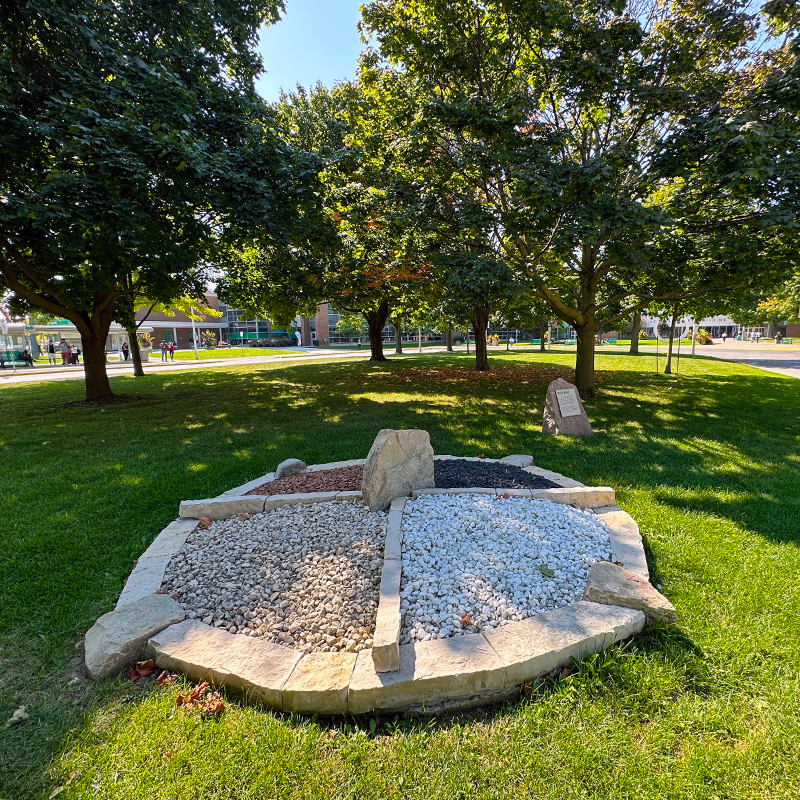
The Oshawa bus loop is home to a Medicine Wheel rock garden. Installed in 2014, it is fittingly located on the bus loop island, where it can serve as a spot for quiet reflection in the middle of our bustling campus.
Used as a teaching and learning tool in Indigenous cultures, the Medicine Wheel represents the interconnectedness that exists in ourselves and the world around us. The wheel’s four quadrants - spiritual, physical, mental and emotional – promote balance in one’s life and living in harmony with all creation.
Durham College is dedicated to advancing truth and reconciliation by weaving Indigenous knowledge and perspectives into the fabric of our campus. Explore this content collection to learn about the resources, supports and opportunities that are available on campus.
On September 30, Durham College recognizes Orange Shirt Day and the National Day for Truth and Reconciliation, which is a time to reflect and learn about past and ongoing injustices faced by Indigenous peoples and communities.
Orange Shirt Day, an Indigenous-led grassroots commemorative day, was inspired by the story of Phyllis Webstad whose brand new orange shirt was taken away from when she attended her first day at the Mission School at six years of age.
The National Day for Truth and Reconciliation honours the children who never returned home and Survivors of residential schools, as well as their families and communities.
As an education institution, Durham College (DC) plays an important role in advancing Truth and Reconciliation by raising awareness, promoting respect and understanding and fostering learning and collaboration.
To support this, the Durham College Library has compiled a selection of self-directed learning resources leading up to September 30, the National Day for Truth and Reconciliation and Orange Shirt Day.
“By shining a light on the wealth of first-hand stories from Survivors of residential schools, we can all reflect on the historic and ongoing intergenerational trauma the residential school system has had on Indigenous communities, families and individuals, which is an essential part of the reconciliation process,” said Durham College Chief Librarian Catherine Davidson.
Access self-directed learning resources including Phyllis Webstad’s story and books and videos available through DC’s library collection.
Durham College is dedicated to advancing truth and reconciliation by weaving Indigenous knowledge and perspectives into the fabric of our campus. Explore this content collection to learn about the resources, supports and opportunities that are available on campus.
For Durham College’s (DC) Faculty of Media, Art & Design (MAD), actively embedding Indigenous perspectives and knowledge directly into program curriculum is critical to fostering a learning environment that honours and reflects the voices of Indigenous communities.
“Our goal is to provide students with opportunities to engage with Indigenous perspectives in a meaningful way,” says Barry Waite, Executive Dean, Faculty of MAD, DC. “Whether through podcasting, international collaborations, or coursework, we want to ensure students gain a deep understanding of Indigenous viewpoints and experiences, and how to share these stories responsibly.”
One way is through Enactus DC, where students recently produced a podcast series, Founder’s Drive, aimed at highlighting the stories of young Indigenous entrepreneurs. This project, celebrated at the Enactus Canada Regional Exposition, not only amplifies Indigenous voices but also inspires students by showcasing the potential of social entrepreneurship in Indigenous communities.
Navraj Sandhar, a recent graduate from DC’s Journalism and Creative Writing program, was the project lead for season two of Founder’s Drive, and said it was an eye-opening journey in many ways. “The Indigenous focus of this season intrigued me from the very beginning. I had the privilege of learning directly from community leaders during our trips to Akwesasne territory and the Native Canadian Centre of Toronto,” he said. “Each conversation taught me more about Indigenous ways of thinking and learning, like how entrepreneurship can be used as a tool for preserving traditions, supporting the community, and creating something that lasts for future generations.”
Looking forward to its next Faculty Lead Classroom Abroad (FLCA) trip this fall, Waite reflected on DC’s FLCA trip to Guatemala last October, where students worked alongside Mayan youth to create and share stories about Indigenous rights in Canada and Guatemala. “The trip not only broadened students’ worldviews but also allowed them to witness firsthand the importance of storytelling in Indigenous cultures,” he adds.
Additionally, first-year students in DC’s Broadcasting – Radio and Contemporary Media program take the course Indigenous Perspectives in Contemporary Media, which addresses the Truth and Reconciliation Commission Calls to Action, particularly around the role of media. This is further complemented by the Journalism – Mass Media program, where students explore impactful storytelling with Indigenous communities through elective courses.
“Indigenous content isn’t just an addition to our programs,” Waite says. “It’s an essential part of preparing students to be culturally aware and socially responsible communicators. It also reflects our commitment to meeting Recommendation 86 from the Truth and Reconciliation Commission that calls on media schools to provide robust education about the experience of Indigenous peoples in Canada.”
These initiatives within DC’s Faculty of MAD contribute to the college’s broader mission to equip students with the tools to engage with reconciliation efforts meaningfully, and as storytellers, ensuring that Indigenous voices are not only heard but also respected and amplified.
Durham College is dedicated to advancing truth and reconciliation by weaving Indigenous knowledge and perspectives into the fabric of our campus. Explore thiscontent collectionto learn about the resources, supports and opportunities that are available on campus.
Nestled within the Centre for Collaborative Education is an inclusive space dedicated to supporting Indigenous students at Durham College (DC).
First opened in 2011, the First Peoples Indigenous Centre (FPIC) was given the Anishinaabemowin name Suswaaning Endaajig, “a nest away from home,” by Elder and Traditional Knowledge Keeper Gerard Sagassige. Since then, its mission has centred on reconciliation, cultural awareness, and creating opportunities for Indigenous students to succeed while staying connected to their heritage.
It also plays a crucial role in raising awareness of Indigenous cultures and histories among DC students, faculty members and employees, bridging the gap between communities and promoting healing and inclusivity.
“FPIC is a resource for anyone interested in learning about Indigenous cultures, histories, and ways of knowing. We offer a range of programs and events that promote cultural understanding and reconciliation, and we encourage everyone to get involved,” explained Dr. Kayla Murphy, Director of Indigenous Initiatives and a member of Walpole Island First Nation. “We provide cultural resources, academic support, and a sense of community. FPIC is a place where students can come together to learn, grow, and build mutual respect.”
When FPIC’s doors are open between the hours of 8:30 a.m. and 4:30 p.m., all are welcome to stop in for a visit. Whether exploring their Indigenous identities or finding a quiet spot to study, it’s a great place to escape from the hustle and bustle of campus life. The coffee is always on and Sherry Miller, Indigenous Student Success Coordinator and a member of Wasauksing First Nation, is always ready to greet visitors with a smile.
“We’re a strong support system for Indigenous students. We offer a sense of home and a strong sense of community,” said Miller, who is passionate about providing a warm and safe environment for those who need it.
“I know there are certain places where Indigenous youth don’t feel safe or they don’t feel welcome. When they come in here, there’s no judgment. Having a space dedicated to them where they can feel safe is important.”
One such space within FPIC is the Elder’s Room. It’s a place for quiet reflection as well as smudging, a sacred ceremony in which traditional medicines like sage, cedar and sweetgrass are burned to purify body, mind, heart and Spirit.
For Kiana Cress, Indigenous Communities Outreach Coordinator and a member of Garden River First Nation, joining the FPIC team feels like a natural extension of the time she spent in similar facilities during her own post-secondary journey. Much of it was spent researching the influence of the education system on Indigenous identities, cultures and languages, making her ideally suited for the task of building new relationships and communities at DC.
“Working directly with Indigenous people is very fulfilling professionally, but also personally,” she said. “Places like FPIC show that Indigenous folks are still here. We’re learners and we’re academics.”
With its commitment to building relationships between Indigenous and non-Indigenous communities at DC, FPIC is supporting the cause of reconciliation. Students and employees can do the same by educating themselves on the resiliency of Indigenous people, their histories and current issues, and by building respectful and reciprocal relationships with their communities.
“My experience at FPIC and DC has been incredibly fulfilling,” said Dr. Murphy. “Whether it’s planning cultural celebrations or providing educational workshops, we’re making a real difference.”
Durham College is dedicated to advancing truth and reconciliation by weaving Indigenous knowledge and perspectives into the fabric of our campus. Explore this content collection to learn about the resources, supports and opportunities that are available on campus.
When considering your academic future, you need to make an informed decision. At Durham College (DC), our student ambassadors are happy to answer all of your questions about post-secondary life.
Launched last year, the Student Ambassador program is comprised of more than a dozen students from various Faculties and programs who are available to provide valuable insights, answer questions, and offer support to their incoming peers as they navigate this new chapter in their lives. New DC applicants can message the ambassador of their choice and they will receive a response within 48 hours.
“It’s about making connections,” explained Magdalena Ramzia, a Conversion Specialist in DC’s Admission Services. “Looking into colleges or programs can be such an overwhelming process, and there are a lot of questions that can’t be answered by staff.”
That’s where ambassadors like Rahesh Doshi come in. As an international student, he has been uniquely suited to advising newcomers to Canada about the changes and challenges that come with studying abroad.
“I loved answering their queries, guiding them and making a positive impact on their journey,” he said.
Andrew Skerritt was once one of those students. His decision to come to DC for the Supply Chain and Operations – Business program was greatly influenced by the student ambassador he spoke to. Now entering his second year, he has sought out the opportunity to become an ambassador himself.
“It was so helpful to me, and I wanted to give back,” he said. “We all appreciate a guiding hand to help us get comfortable in a new environment, and that’s what the Ambassador program does. That’s priceless to me.”
At Durham College (DC), we understand that the decision to return to school is not taken lightly. Finances, academic performance and employability are all likely on your mind. But know that you’re not alone – more than 60 per cent of DC students come with work and life experience and not directly from high school – so we know exactly what you need to succeed.
We’re here to support you and want to address three of the most common concerns we hear about most from mature learners to put your mind at ease and inspire you to take action toward this exciting new chapter.
“I don’t know if I can afford to return to school.”
We know that one of the biggest worries for mature learners is the cost of returning to school. You might wonder how you’ll manage tuition, books, and other expenses. Finances shouldn’t be a barrier to education, so at DC, we’re proud to offer more than $5 million in scholarships, awards, and bursaries to our students each year, based on factors such as academic performance and financial need. Many mature learners are eligible for specific support, and our team will work with you to create a financial plan that fits your budget.
Our Financial Aid and Awards office is here to help you navigate your options and find a solution tailored to suit your individual needs. From finding and applying for bursaries and scholarships to gaining flexible on-campus employment, their guidance and support is invaluable.
Looking for inspiration? Check out this mother-daughter duo, who together, found Financial Aid to be a cornerstone of their time at DC.
“I’m worried I won’t be able to keep up with my studies.”
If it’s been a while since you last stepped into a classroom, lab, or shop, you might be concerned about meeting academic requirements or keeping up with coursework. Don’t worry — DC offers several options to help you succeed, including a free Academic Upgrading program, which is designed to help mature learners refresh their skills in subjects like math, English, and science.
In addition, our Student Academic Learning Services (SALS) team is comprised of dedicated on-campus professionals who are ready to assist you through one-on-one appointments, group tutorials, workshops, and online resources to help boost your grades.
Read more about how SALS is ready to support you from your first day of class to graduation.
“I want to know I’ll get a job in my field after graduation.”
Employability is often top of mind for mature learners. You want to know that your investment in education will lead to tangible career opportunities.
Our data tells us that nearly 90 per cent of DC grads are employed within six months of graduation. This is because our programs are developed with employability in mind and to ensure students graduate career ready. We work directly with industry partners to ensure that our curriculum reflects the skills and knowledge employers are looking for. With experiential learning opportunities infused within program learning outcomes, you’ll gain practical, hands-on experience that sets you apart in the job market.
DC provides on-campus Job Fairs, program-specific networking opportunities with employers and alumni events tailored to assist you in landing your dream job. Also, the Career Development office offers workshops, resume writing assistance, and access to a free online job portal, exclusive to DC students and alumni.
At DC, we believe that it’s never too late to pursue your goals – and we’re here to help you reach them. Connect with our Student Recruitment team today to launch your future career!
Starting college is a big milestone, and attending orientation can set the tone for a successful journey.
Participating in both virtual and in-person orientation events makes easing into life at Durham College (DC) a snap and will help you get connected to and involved in campus life. Here are our top picks for things to do during DC Orientation.
Get to know your faculty and program
Start your academic journey with a Faculty Welcome during Academic Welcome Week from August 27 to 30. Attend this half-day event and get to know your faculty and participate in your program-specific orientation. Cap off the event with social and wellness activities, enjoy light refreshments and snacks and snag some DC swag. Find your Faculty Welcome date here!
Get prepared with the Start Strong series of events and workshops
DC’s Start Strong series is designed to give you an in-depth knowledge of your campus and college services. Events include first-year tours of both our Oshawa and Whitby campuses and online sessions to help you learn more about important services like athletics and recreation or explore the balance and well-being workshop. Explore our Start Strong events and sign-up here!
Don’t forget to complete PREP 1000, DC’s first-year experience course for new students. This free online course is available a month before classes and will help you learn how to select your timetable, apply for financial aid, purchase your books and register for Student Academic Learning Services (SALS). Finish your PREP 1000 modules by the end of September and you’ll automatically be entered into a draw to win one of two $250 campus gift cards.
Get involved with fun social activities and campus clubs
Meeting new people and connecting is one of the best parts of a college experience and the next few weeks are filled with opportunities to get out and get to know people on campus! Fun social activities include DC Movie Night on the Lawn and video game tournaments at the DC Esports Arena.
Our Orientation website is a one-stop-shop listing events and connecting you to resources. Check out our handy checklist of administrative tasks prior to starting college or browse our Frequently Asked Questions page for a comprehensive list of topics. We’ve got answers to your questions!
In 2019, Rania Watts stood at a crossroads in her life. Encouraged by her husband to fulfill her dream of furthering her education, she began a journey that would soon include her daughter, Jordan. Together, they discovered a community of support and opportunity at Durham College (DC).
"My husband is the catalyst of this story," shared Rania. "When I graduated from Centennial College in 1997, I always wanted to go back to complete my education after earning a Social Service Worker Diploma. However, I ended up working right away. In the fall of 2019, he encouraged me to return to my studies."
Rania’s search for the right program led her to the Victim Justice and Interventions graduate certificate at DC. "I found the support I received from the staff to be tremendous," she says. This experience motivated her to explore more programs, leading to her application to the Behavioural Science – Honours Bachelor degree (HBBS) program. "Let's put it this way, there was a lot of screen refreshing until the acceptance was received at 1:48 a.m. early on a Thursday morning.”
Jordan, inspired by her mother's enthusiasm, decided to join her at DC. "When I was in Grade 11, my mom told me how good the atmosphere was at Durham College. Though she was online, she loved the support provided to her," Jordan said. Passionate about art, she enrolled in the Fine Arts – Advanced diploma program. "It was comforting to attend school where I had a personal connection."
Returning to school after nearly 25 years was daunting for Rania. Concerns about finances, academic performance, and being decades older than most students made her a little nervous, however, the Financial Aid and Awards office at DC helped alleviate some of these worries. "DC made it very clear that they would do everything in their power to help me," she says.
The Financial Aid and Awards office at DC was a cornerstone of Rania and Jordan’s college experience. Rania, managing a tight budget while supporting three children, calls DC’s informative webinars “amazing” and is where she discovered DC’s bursaries and the benefits of OSAP.
We work with students to uncover their unique circumstances and then assist with creating a financial plan to help them through college. Teaching students how to manage their finances is also a big part of what we do as well.
Celeste ColesManager, Financial Aid & Awards, Durham College
Rania has received a number of bursaries throughout her time at DC, including the Entrance Award for the Behavioural Science Degree, DC’s General Bursary, and the Eva Loraine Cornish Memorial Award. For Jordan, bursaries such as the Durham College General Bursary and the Roger Anderson Charity Classic Award have provided much-needed financial relief.
"The amount of support we received was immense; not just financial, but emotional as well," said Rania.
For Jordan, who was transitioning directly from high school to college, she struggled with anxiety and worried about maintaining good grades and staying passionate about her program. Thanks to DC’s supportive environment, these fears quickly faded, and she found comfort in the kindness and patience of DC’s employees. "From the moment I applied to DC, I knew I was in the right place," she said.
Rania was particularly impressed by the college’s emphasis on mental health and self-care. "One of the reasons that I decided to stay at DC was because of the support that I received from all of my professors while I was studying Victim Justice and Interventions," she says.
Looking forward, Rania intends on completing the HBBS program, and returning to DC for the Music Business Management advance diploma program. And Jordan looks forward to graduating from Fine Arts.
Whether you’re returning to school after many years or transitioning directly from high school, DC’s services and supportive community are there to help you every step of the way. "There is a solid infrastructure in place that offers innumerable support," said Rania.
 App Store
 Google Play